
I have been going to the BFI a lot lately, mostly to watch the selection of early Chaplin shorts they have been showing, with live piano accompaniment. What strikes me after watching these early gags is that they amplify my (already substantial) appreciation of Chaplin's later, and truly great work a la Modern Times, City Lights, The Circus...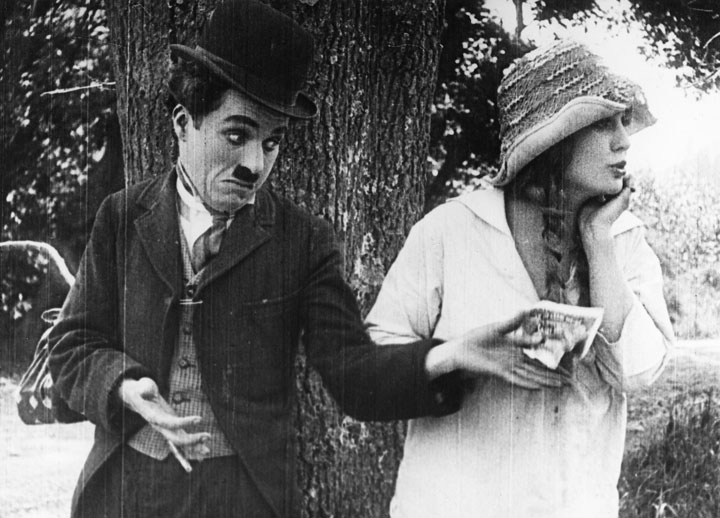
They illustrate retrospectively the enormity of the critical leap made by Chaplin: transferring the 'little tramp', a comedic character designed for these 15-20 minute slapstick, slapdash, silent 'sitcoms' whose sole purpose is entertainment, into the radically different context of full length feature films dealing with 'big themes'; turning the Tramp's apparent weaknesses as a 'serious' dramatic instrument - principally his vaudevillean, two-dimensional silent-screen naïveté - into a superb critical tool, and casually deploying along the way a wealth of excellent commentary on everything from love and relationships to social class, capitalist industrialization, and the rise of Nazism. (at a time when Hitler was still somewhat of a visionary hero in America and Time's 'man of the year', while Chaplin's The Great Dictator was received with derision by the public at large, only later to be hailed as a work of prescient genius.) 
One could argue that Benigni does something like this in La Vita è bella; but the achievement is clearly nowhere near as original, extensive, or impressive. I do not necessarily agree with those of his critics who found his treatment of the Holocaust as offensive; he simply never achieves anything like the same critical depth or richness. One could even argue that there are grounds for 'offensiveness' in Benigni's treatment, not so much for his use of comedy, but for his doing it without the two-dimensional naïveté and innocence of Chaplin's Tramp, without the proper distance (Benigni's is ultimately a serious character who knows what is going on but protects his son by inventing a fairy tale)...
Admittedly, even in some of Chaplin's early shorts there are occasional flashes of brilliant social commentary, particularly on matters of social class. And the Tramp's very being who he is, is in a sense already a subversive move which it is all too easy to take for granted: it is not simply that he is a 'tramp', a specimen of the lowest of the 'lower classes'; it is precisely his free-wheeling nonchalance, his lack of any acute awareness of or anger about his own plight - his two-dimensionality - that is most subversive...
The Tramp, despite the passage of time, is simply unparalleled.
Tuesday, 16 September 2008
Early Chaplin Shorts: The Little Tramp as Critical Tool


Thursday, 11 September 2008
Those Theremin Blues

Tuesday night I went to an experimental/noise gig at Oto Cafe in Dalston, PAMELIA KURSTIN + JOHN BUTCHER. Pamelia Kurstin (the headline act) plays the theremin, one of the earliest electronic instruments, and the first instrument ever to be played without being touched. It was designed by Russian scientist Leon Theremin in 1919.
Theremin demonstrated the theremin shortly thereafter to Lenin (that's Vladimir Ilich Ulyanov, not John...Lennon); the latter was so impressed that he started taking lessons on it, and later commissioned hundreds of them to be built and distributed around the Soviet Union - and the world, to demonstrate Russian technology and promote electronic music.
A modern-day theremin; the rod controls the pitch/modulation, while the loop controls the volume/texture, which is done simply by adjusting the position of your hands in the air.
Anyway, Kurstin is apparently one of only a very few people who play this instrument as a real instrument, and as a trained musician (rather than a geek fooling around with a sci-fi gadget); and she is bloody good, in spite of being very drunk from the start. Watching someone play it, especially in a particular kind of setting, with dim lighting and in total silence, was a bit surreal. It inspired me to make an eerie horror/mystery film using only her music. Something to think about.
John Butcher was good too, and way more experimental. Tapping on the saxophone keys, on the reed, without blowing, passing air through the holes, squeaking, grinding, twisting, turning - at one point stuffing the microphone into the hole of the sax...
Both acts, but especially John Butcher, made me think of Heidegger and 'tools'. How things emerge in consciousness only when they break down/cease to function as they should; how any instrument, even when played 'normally' makes a whole range of sounds that we never hear or associate with it - a whole world of sonic exertion that in 'normal' circumstances remains hidden from our ears.
Tuesday, 9 September 2008
In Praise of Invective
Reading Zizek's recent piece in In These Times on the 'audacity of rhetoric', and on the heels of my vituperative tirades against leftist apologia for Serbian ethno-fascism in a lengthy exchange of comments on Lenin's Tomb (of which I will write more later), an SWP mouthpiece operated by blogger Richard Seymour ('Lenin'), I was reminded of this piece (below) published in the 'Readings' section of Harper's a few years ago. Despite its vaguely anti-Communist or at least apolitical stance, I like the way it smacks soothingly of Heideggerian 'resoluteness'. In fact, given that Simic is writing here as an American for an American audience, the neutralising sentiment perhaps isn't even vaguely anti-Communist; it aims precisely at leveling, insisting that even in "our democratic society" one must equally be alert as in any the 'Communist countries', suggesting that the liberal notion of 'freedom of speech', in its negative determination defined according to constitutional prerogative - a freedom embedded or 'objectified' in collective thinking in a liberal society - is, well, a bit of a myth. (I love the bit about the boy writing to President Johnson.) So perhaps it isn't even so much apolitical as anti-ideological, encouraging the cleansing operation of undermining or disturbing the background, encouraging one to reveal the hidden suppositions embedded in our speech and thought, the almost inevitable embeddedness of our daily existence, the pernicious presence of 'the they'. (And mind you, given Simic's Yugoslav background, I might add, if there is a single reason for any foreigner to learn our needlessly complex and obscure language, it is for its notoriously rich and varied 'stock of maledictions'):
***
[Appreciation]
IN PRAISE OF INVECTIVE
From an essay by Charles Simic in Orphan Factory, a collection of Simic's writing to be published in October by the University of Michigan Press. Simic was born in Yugoslavia; he now lives in New Hampshire. Simic received the 1989 Pulitzer Prize for poetry.
At the end of a murderous century, let's curse the enemies of the individual. If, in order to do so, we must fall back on the vocabulary of abuse, so be it.
This is what I learned from twentieth-century history: Only dumb ideas get recycled. Every social reformer longs to be the brains of an enlightened, soul-reforming penitentiary. Everyone who is vain, dull, peevish, and sexually frustrated dreams of legislating his impotence. The image of a billion people dressed in Mao's uniforms and shouting from his little red book continues to be the secret hope of new visionaries.
So, against ideologies from nationalism to racism, let us wield what the poet Cornelius Eady calls "the tongue we use when we don't want nuance to get in the way."
The first and never-to-be-forgotten pleasure that language gave me was the discovery of "bad words." I must have been three or four years old when I overheard my mother and another woman use the word "cunt." When I repeated it myself, when I said it aloud for all to hear and admire, I was slapped by my mother and told never to use that word again. Aha, I thought, there are words so delicious they must not be said aloud!
I had a great-aunt who used such language every time she opened her mouth. My mother would beg her, when she came to visit, not to speak like that in front of the children, but my aunt paid her no mind. To have a temper and a foul mouth like that was a serious liability in a Communist country. "We'll all end up in jail because of her," my mother said.
There are moments in life when true invective is called for, when it becomes an absolute necessity, out of a deep sense of justice, to denounce, mock, vituperate, lash out, in the strongest possible language. "I do not wish to be weaned from this error," Robert Burton wrote long ago in his Anatomy of Melancholy. I agree. If there is anything I want to enlarge and perfect, it is my stock of maledictions.
Once one comes to understand that much of what one sees and hears serves to make fraud seem respectable, one is in trouble. For instance, long before Parisian intellectuals did so, my great-aunt had figured out that the Soviet Union and the so-called people's democracies were a scam and a lie from the bottom up. She was one of these women who sees through appearances instantly. To begin with, she did not have a good opinion of humanity. Not because she was a sourpuss and a viper's nest of imaginary resentments. Far from it. She liked eating, drinking, a good laugh, and a quick roll in the hay behind her elderly husband's back. It's just that she had an unusually uncluttered and clear head. She would tell you that our revolutionary regime, which regarded loose tongues and levity as political crimes and those caught in the act as unhealthy elements, was a huge pile of shit, and that included Marshal Tito himself. Her outbursts were caused by what she regarded as other people's gullibility. As far as she was concerned, she was surrounded by cowards and dunces. The daily papers and the radio drove her into verbal fury. "Admit it," she'd yell at my mother and grandmother. "Doesn't it turn your stomach to hear them talk like that?"
If they agreed and confided in a whisper that yes, indeed, these Commies are nothing but a bunch of murderous illiterate yokels, Stalinist stooges, and whatnot, she still wasn't happy. There was something about humans as a species that worried her to no end. Cursing them, I imagine, gave her royal pleasure and, unknown to her, gave pleasure to me too, listening behind the closed door with a shameless grin.
I knew a thirteen-year-old boy who wrote a letter telling off President Johnson for the conduct of the Vietnam War. It was some letter! Our president was an idiot and a murderer who deserved to be napalmed himself, and worse. One evening, as the boy and his mother and sister were sitting around the kitchen table slurping their soup, the doors and the windows leading to the fire escape flew open at the same time, and men with drawn guns surrounded the table. "We are the FBI," they announced, and they wanted to know: Who was Anthony Palermo? The two women pointed at the boy with thick glasses and crossed eyes. Well, it took a while to convince them that he was the one who wrote the letter. They were expecting a full-grown assassin with long hair and an arsenal of weapons by his side.
The obvious point here is that the vileness and stupidity my aunt found so enraging is not limited to Yugoslavia or Eastern Europe or Communism but is alive and well and should be railed at, with our most pointed and inventive tongues, in our own democratic state.
"What do you want from me, blood?" I once heard an old woman shout at the workers in a New York City welfare office. She then kept cussing for another five minutes, not because she had any expectation that the wrongs done to her would be righted but simply in order to make herself feel good and clean for one brief moment.
-Charles Simic
***
Amen and Hallelujah. So, here's to Richard Seymour 'Lenin' and all the other proto-fascist imbeciles and leftist apologists for Serb genocidal pretensions, at the SWP and elsewhere, for whom my only wish is that they rot forever in hell, preferably under intense Serb artillery bombardment with their friends Karadzic and Mladic at the helm.
Friday, 5 September 2008
Weaning Hearts and Minds
Present-day British and American colonialists in Iraq and Afghanistan, with all the bullshit rhetoric about 'winning hearts and minds' could really learn something (about not invading countries) from the Partisan example. The only real victory in war is 'moral' victory, and after more than five years - longer than WWII - neither conflict (Afghanistan/Iraq) is over. Here are a couple more interesting bits from Hoare's book, Genocide and Resistance in Hitler's Bosnia: The Partisans and the Chetniks, 1941-1943:
"The Serb Partisan Ilija Vukoman recalls that in Central Bosnia: 'The Muslim women used to hide themselves - they wore the veil. I passed hundreds of times by the house of Muharem Baric and his wife without ever seeing her face. When the uprising began and work for the People's Liberation Movement got underway, Muharem's wife and many other Muslim women ceased hiding themselves from us.' [footnote omitted]"
"Zaga Umicevic-Mala recalls a young Muslim woman she met in Banja Luka, Nazifa Isakovic, who was recruited into the NOP by her brother Zaim, a Communist. Nazifa worshipped her brother and would carry out any task for the movement that he asked of her but, she told Umicevic-Mala, 'the only thing I could not do would be to take off my veil'. Two years later Umicevic-Mala met Nazifa again, as a Partisan and without her veil. 'Her blonde hair was flowing in the wind and her big blue eyes were happily gazing at the world around her.' Umicevic-Mala asked: 'Naza, what's happened to your veil? Do you remember what you said to me at Banja Luka?' Nazifa replied: 'I did not know how wonderful it is to gaze at the world without a headscarf'."...(287)
Yep, that's what happens when you actually inspire people. And guess what, boys - you don't inspire people by invading and demolishing their countries and homes, terrorising them, murdering their relatives, putting them in prison, cuffing them, stuffing them full with McDonalds and Kentucky Fried Chicken and Burger King and bullshit rhetoric about democracy and human rights, and shoving ballots in their faces. Nope. Capitalism inspires fuck all.
Partisan Women: Bloodthirsty Harpies of National Liberation?
Since I started writing about my communist partisan grandparents, I have done some casual research into Yugoslav/Bosnian WWII history. One interesting recent book I came across covers the period 1941-43, and in particular the 'civil war' between the Partisans on one side, and the Chetniks - Serbian nationalist/royalist paramilitaries, predecessors of contemporary Serbian nationalists. The Chetniks, on account of very effective propaganda through a long-established and influential Serbian lobby in the West (descendants of the Royal family reside in England to this day)**, actually received Allied support until 1943, when Allied spies dispatched to both sides reported that the Chetniks were in fact collaborating with the Germans while the Partisans were fighting against them. The Allies officially (and grudgingly, given the Partisans' communist agenda) switched their support at the Tehran conference.
The feats of the Yugoslav Partisans in WWII are the stuff of legend. These were not mere warriors - they were a representative cross-section of the society that spawned them. They even included some of the greatest artists and writers of 20th century Yugoslavia, who immortalized the struggle in literature, film, and fine art. For those of us who grew up with these stories the names of places and battles reverberate with a mythological power - The Battle of Sutjeska, The Igman March, the Battle of Neretva...Through the haze of childhood recollection the protagonists of these tales are endowed with an almost super-human strength and cunning in overcoming their far more powerful Nazi opponents. But what if there is indeed a real dimension of this struggle that is, well, not super-human, but super-(man)?
It is generally accepted that in spite of their technological and military weaknesses early in the war, the Partisans had two main advantages over their enemies:
1. a small but very effective cadre of Spanish Civil War veterans from the International brigades who, unlike even many German troops, had valuable experience of modern warfare (the Spanish Civil War is arguably the first truly modern war, at least on European soil), and
2. broad popular appeal due to the fact that their founding aims were political rather than ethnic or religious, allowing them to draw recruits across national, ethnic, religious, and other boundaries.
There is one under-explored dimension of this second point: the role of women. Many people don't realize just how radical Tito and co's project of national liberation was, and how deliberate they were in taking measures to reshape society from top to bottom. Here is one interesting passage from Hoare's book:
"...The group of Bosnians most excluded from political life prior to the Axis invasion was the female half of the population, which represented a larger proportion of the country's inhabitants than Serbs, Muslims, or Croats. In his seminal study of the Chetnik movement, Jozo Tomasevich noted the role of women in the Partisan victory: 'One of the fundamental differences between the Chetnik and Partisan movements was in their attitude toward women. The participation of women in Partisan fighting ranks and mass organisations of the Partisan movement was of such importance that all Partisan officials agreed that without the women the Partisans could never have won.' [footnote omitted] ...Male supremacy over women was as much a part of traditional rural society as religious semi-segregation. In overturning the one the KPJ helped to undermine the other, for the dissolution of traditional boundaries between men and women and between Orthodox, Muslims, Catholics, and Jews was part of the same process of turning 'peasants into Bosnians', a process inimical to the Chetnik project that upheld traditional social distinctions." (Genocide and Resistance in Hitler's Bosnia: The Partisans and the Chetniks, 1941-1943, 285-86.)
On the point about 'turning peasants into Bosnians' my grandpa's story, as told in the previous post, is a case in point. How successful this was, well, my grandma may have a few things to say about it, but I think we're in overall agreement. (Apparently whenever people tried to psychologize my grandpa's behaviour, she would explain that, as a peasant at heart, he had no such thing as a 'psyche')
Nonetheless, it gets even more amusing. To anyone interested in this topic I would recommend reading the entire chapter in Hoare's book which chronicles, among other things, touching episodes of Muslim women shedding veils and other niceties in joining or collaborating with Partisan ranks. Here are some other interesting bits:
"The prominent role of women in the Partisan movement inevitably found a role in the demonology of its right-wing enemies. An Ustasha report on Partisan atrocities in Prijedor, following the capture of the town in May 1942, claimed: 'Women, both from Prijedor and from the surrounding area, played a particularly prominent role in these bestialities'. [footnote omitted]...The Ustashas' Department of Public Security claimed in an internal report of September 1942 that the Partisans 'are in many places bloodthirsty, particularly the female persons in their ranks.' [footnote omitted] For their part, the Chetniks distributed a pamphlet in eastern Hercegovina in late 1942 claiming that among the Communists were many 'fallen and unfortunate women and girls without morals' [footnote omitted]...Partisan women were therefore the polar opposite of true, martyred Serb women. In Draza Mihailović's view: 'Communist women are recognisable by the fact that they are immoral; using free love they approach and seduce our men, particularly those who place fun above duty.'[footnote omitted]" (288-89)
While I am having difficulty picturing my grandma as a bloodthirsty berserker harpy, I find it amusing to imagine the chill these fascists must have gotten to see women carrying guns and screaming communist slogans. One old Partisan anthem we all sang as kids is about a mlada partizanka - a young Partisan woman - who threw grenades at the enemy...
One could even argue that the presence of women helped turn the tide of the war not just quantitatively by inflating the ranks of the Partisans, but additionally in a qualitative way, by the effect on morale - building solidarity in the ranks irrespective of religious, ethnic, or gender differences, and demoralising their enemies, or simply scaring them shitless at the sight of this weird hybrid fighting machine.
This should in no way lead to any sympathy with the contemporary American project of nation-building or reshaping other societies: the partisans, who sought to reshape their own, were strategically precisely in the position of the mujahideen - the crucial difference being that they were fighting for unification and liberation, rather than segregation and imposition of strict religious codes. The crucial element lending to the effectiveness of their struggle, and to the unique position of Yugoslavia in the Cold War world after its break with the Soviet Union, is national self-determination.
Going back to the broader issue of political appeal and the enfranchisement of the excluded, does this not go some way toward explaining why the vast majority post-colonial national liberation movements worldwide - even those spawned without any direct outside superpower involvement - were communist or socialist? Doesn't any national liberation struggle, in order to be truly successful, require this kind of breaking-down of ethnic, religious, gender, and other boundaries?
This is precisely the way to unite the different struggles: workers, women, oppressed minorities... In order to effectively confront a common external enemy, a nation must first shed its own internal demons; and perhaps the reason why Yugoslavia broke apart in the end is because this work was never thoroughly completed. The decades of Tito's 'brotherhood and unity' only relatively froze the post-war breakdown, nationalism in particular was never properly dealt with...(And here it may be worthy to concede, grudgingly, Žižek's point about the Jacobins and revolutionary terror - the French republic they inaugurated remains intact 200 years later, and it looks like it will survive even Sarkozy - so perhaps the Partisans simply weren't extreme enough...)
One should equally not be deterred here by the fact that Capital - once the sole preserve of wealthy white men - has in the meantime found ways to accommodate, commodify, and even commandeer the rhetoric of multi-culturalism, human rights, equality, etc. This is in its nature, as Deleuze and Guattari argue - deterritorialization. Yet we should never forget that these are the fruits of hard-won battles against Capital - even against liberalism,in its earliest incarnation. Why simply give up on this legacy and allow liberal Capital to mediate its impact and reterritorialize the gains for political 'street cred'?
One thing that some people today are shocked to hear, for instance, is that Swiss women - Switzerland being the darling of Global Capital, hosting a number of multinational corporations way out of proportion to its size - only gained the right to vote in 1971, by a national referendum in which one-third of the all-male electorate voted against suffrage. (One Swiss canton only granted women full suffrage in 1990!) And even after suffrage many discriminatory measures remained in place for years, such as husbands' control over their wives' property and capital, the husband's right to decide on the couple's place of residence, etc. Switzerland, until fairly late in the 20th century, is like some perverse modern capitalist version of the Taliban. Isn't this the best proof that modernity alone, not to mention its capitalist variant, is no guarantee of freedom, equality, human rights, etc - and that simply imposing 'democracy' is a hollow gesture when it comes to true liberation?
Without overemphasizing the value of the democratic vote - one always has to wonder why a particular freedom is being granted at a particular time and to what end the political credit gained by those in power is being deployed. The end of colonialism is often seen as merely the transition or sublation to another form of colonialism - a version of what Hardt and Negri call Empire, what others have called economic imperialism (although 'Empire' goes beyond political economy, as a new incarnation of old state sovereignty); similarly, one could say that democratic reform is permitted when the power elite has sufficiently insulated itself from it, and this is ultimately the problem with gradualism.
But the answer to this predicament is not to throw out the baby with the bathwater. It is rather, keep the bathwater, and throw out the baby - insist on change, democratic or otherwise, but insist on it, as Martin Luther King did, now. Not when those in power find it suitable to throw some scraps from the table. Seize the revolutionary moment, intervene to change the very coordinates of what is deemed 'possible', to put it in Žižekian terms.
**This same lobby/propaganda machine has in recent years caused much of the confusion surrounding the Balkan wars of the 1990s, ironically pulling many Western leftist intellectuals (notably Chomsky and Parenti) into the ranks of apologetics for military aggression and ultimately genocide, under the banner of Serbian nationalism. This is largely due to the grossly mistaken impression that people like Milošević- a rabid nationalist who inaugurated his tenure in 1989, on the 600th anniversary of the battle of Kosovo, by annexing Kosovo and Vojvodina and thus giving Serbia 3 votes in the 8-member national council, prompting the walkout in protest of Croatian and Slovene members - were somehow carrying on the legacy of Tito's Yugoslavia, rather than actively working together with the West to destroy it. One prominent and oft-quoted (ironically even by Chomsky) figure in this project was Gen. Lewis Mackenzie, a Tory politician in Canada and commander of UN forces in Sarajevo early on in the war, who gave testimony before the US congress in 1992 arguing against any intervention - even humanitarian aid - in the conflict, saying that "all three sides were equally guilty". Mackenzie was later revealed to have been on the payroll of a Serbian-American lobbying group while on a speaking tour following the publication of his book on Bosnia. Similarly, Diana Johnstone, who published a book supposedly debunking Serb atrocities in Bosnia, was refused further publication by In These Times - a leftist paper in the US for which she had regularly written - when the editors discovered that she was an old college friend of Mirjana Markovic, Slobodan Milošević's wife. (For the sake of comparison, just imagine a supposedly objective journalistic account justifying the Iraq war, presenting 'evidence' that there were indeed WMD in Iraq, that the Abu Ghraib photos were faked, there was no torture, the civilian death toll was exaggerated, etc - written by an author who turns out to be an old college friend of, say, Dick Cheney's wife. I actually had an e-mail debate about this with Chomsky, and I gotta say, Noam, I know it's hard to admit you were wrong, let alone taken for a complete fool, but sometimes you just gotta do it.)